What does lotus leaf extract do?
Lotus leaf extract, a plant-based botanical ingredient, is standardized with the known phytochemicals present and offers a variety of processing properties that can be utilized by formulations in the beverage, food, cosmetic, and nutraceutical industries.
Lotus Leaf Extract Overview in Botanical Ingredient Systems
Today, lotus leaf extract is obtained by extracting and concentrating the leaves of Nelumbo nucifera, with the aim of creating a stable ingredient (powder or liquid) for use in industry.
Raw material sourcing: The dried lotus leaves are used as the main raw material, and they are usually cultivated in an agricultural environment.
Extraction methods: Water extraction, ethanol-assisted extraction, or hybrid solvent extraction are used depending on the aim of the extraction and its target compound profiles.
The commonly used processing techniques for the production of stable lotus leaf extract powder are: filtration, concentration, spray-drying, and vacuum-drying.
Physical form: The Lotus leaf extract is typically a very fine powder (green to brownish green) and is soluble in a variety of media.
Standardisation focus: In the manufacturing side, consistency of flavonoids and alkaloids is important for the predictability of formulations.
Lotus Leaf Extract Composition and Functional Phytochemical Profile
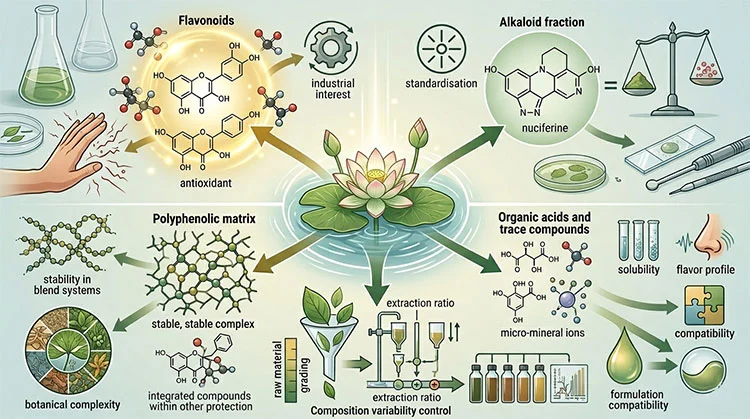
Lotus leaf extract is a composite of several natural compounds that affect the application behaviour in the industrial formulation process.
Flavonoid compounds contain Quercetin and Kaempferol derivatives, which form part of the interest in formulation in relation to antioxidants.
Alkaloid fraction: It contains alkaloids of the family, which are normally used for standardisation purposes, such as nuciferine.
Polyphenolic matrix: Provides stability in blend systems and adds botanical complexity to the system.
Organic acids and trace compounds affect solubility, flavor interactions, and formulation compatibility.
Its composition variability control: It can be adjusted by using different extraction ratios and raw material grading.
Lotus Leaf Extract Usage in Beverage and Liquid Formulation Systems
Lotus leaf extract is widely used in liquid-based manufacturing because of its dispersibility and the stability of its botanical profile.
Functional drink systems: Powders or liquid concentrates for formulation of botanicals for functional drinks.
Soluble tea products and instant herbal drink powders: Applied in tea and infusion products.
Flavor formulation support: Provides delicate herbs in more complex beverage systems.
Solubility management: It is a requirement that the particle size and carrier used are controlled so that the particle is dispersed evenly.
Stability optimization: The formulation process is carried out with adjustment of the pH and temperature conditions to ensure stability.
Lotus Leaf Extract Application in Food and Nutritional Formulation
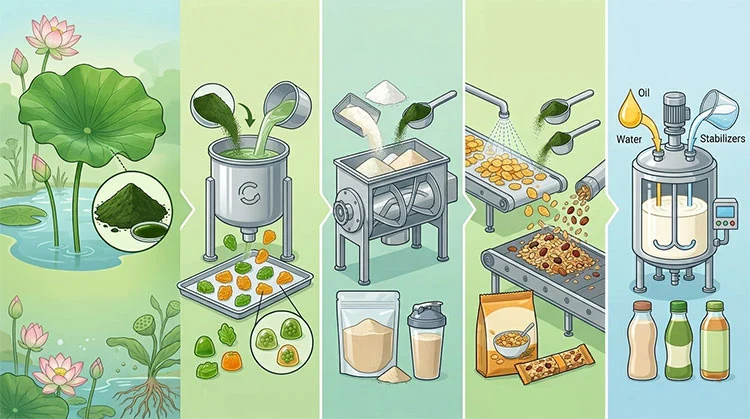
Lotus leaf extract is used as a natural ingredient in structured ingredient systems in food manufacturing.
Gummies: Made as part of plant-based confection systems (may be encapsulated or powdered).
Powdered nutrition blends: In dry mix nutrition products for diversification of functional ingredients.
Cereal and snack systems: Enrichment and botanical labeling systems.
Emulsion compatibility: Stabilizers can be used in conjunction with both oil-in-water and dry blend systems.
Dosage control: Adjusted based on sensory, solubility, and formulation densities.
Lotus Leaf Extract in Cosmetic and Personal Care Formulations
Lotus leaf extract has been used in cosmetic systems as it has a plant source and is compatible with the current formulation bases.
Facial care products: They are applied to the face in the form of cleansers, toners, and masks to position botanicals.
Emulsion systems: Compatible when suitably stabilized with emulsifiers - creams and lotions.
Water-based formulations can be easily incorporated into gels and water-based cosmetic systems.
For fragrance-neutral product lines, offers mild herbal attributes.
Stability requirements: Needs to be protected from: Excessive heat, Oxidation during processing.
Lotus Leaf Extract Stability, Processing Factors, and Formulation Design
Lotus leaf extract performance in an industrial system is greatly influenced by process parameters and formulation design strategy.
Heat sensitivity: May be affected by high heat exposures, color, and compound stability.
pH influence: For consistency, it is generally preferred to have neutral to slightly acidic systems.
Carrier selection: typically, for spray-dried powders, maltodextrin or other suitable carriers are used.
Important characteristics of particles include size and size distribution. Size and size distribution are important characteristics of particles that affect their solubility rate and uniformity of mixing.
Storage conditions: It is recommended to store the product in a dry and sealed environment to ensure the integrity of the product.
Lotus Leaf Extract Market Applications and Industry Integration
Lotus leaf extract is easily adaptable and plant-based, and it is being incorporated into various industrial fields.
The supply chain of botanical ingredients: Distributed in the form of a well-defined raw material for formulation.
OEM/ODM manufacturing: It is used in the development of special products for private label.
Functional product design: Used in multi-ingredient products with the purpose of product differentiation.
Clean Label product trends: Selected for plant origin labelling approaches.
Cross-industry adaptability: adapted for food, beverage, cosmetic, and ingredient blending industries.
What does lotus leaf extract do?
Lotus leaf extract is a multifunctional botanical that can be applied mainly for formulation development in the beverage, food, cosmetic, and nutraceutical industries. It is most useful because of its consistency in its phytochemical content, the ability to process it in almost any manner, and its ability to be utilized in many manufacturing systems. Instead of being used solely as a standalone ingredient, lotus leaf extract is used in the product design as a structural component, which helps manufacturers to design stable plant-based product formulations with quality and use them in different markets.
Contact us today to learn more about our products and pricing. You can send an email to info@scigroundbio.com or submit your requirements using the form at the bottom of our website.
FAQ
Q1: What is lotus leaf extract used for in manufacturing?
It is used as a botanical ingredient in beverages, powders, cosmetics, and food formulations, where they offer flexibility in plant-based composition and formulations.
Q2: How is lotus leaf extract added into beverage systems?
It is normally used as a powder or a concentrate (liquid preparation), which is then mixed under controlled conditions of temperature and pH to attain stability.
Q3: What affects the quality of lotus leaf extract?
Selection of raw materials, extraction method, drying process, and storage stability and consistency are the key factors.
Q4: Can lotus leaf extract be used in cosmetic formulations?
Yes, it's a common ingredient in water-based and emulsion cosmetic formulations to integrate and design formulations for botanicals.
References
1. Zhao, X., et al. (2021). Phytochemical composition and industrial applications of Nelumbo nucifera leaves. Industrial Crops and Products, 170, 113707.
2. Li, Y., & Wang, J. (2020). Optimization of plant extraction processes for flavonoid-rich botanical materials. Journal of Food Engineering, 282, 110026.
3. Kim, S. H., et al. (2022). Stability and formulation behavior of botanical extracts in functional beverages. Food Chemistry, 374, 131710.
4. European Food Safety Authority (EFSA). (2021). Guidance on botanical ingredients in food supplement applications. EFSA Journal, 19(3), 6452.
5. Zhang, L., et al. (2023). Application of plant-based extracts in cosmetic emulsions: processing and stability considerations. Cosmetics, 10(2), 45.
You may like